
Wednesday, December 14, 2011
South Carolina and other states secede
With America on the rocks, and war breaking out the South felt the need to secede. Virginia seceded first, they did so by passing an Oridinance of Sucession on April 17, 1861. The Confederacy responded by moving the capital to Richmond, Virginia. By early June of 1861, Arkansas, North Carolina, and Tenessee has also seceded. Lincoln didnt want to lose anymore states, and he was willing to do anything to keep America together. To prevent Maryland from seceding he ordered martial law there, to keep them under control. Lincoln also promised to leave those states that were undecided alone, as long as the Confederacy did so too. But later, the nuetral Kentucky people became angery, because Confederate invasion, they decided to go against the Confederates in the war. Missouri was also able to stay in the Union with federal forces. Now the only issue was how the preservation of America would play out on the battlefield.

Ft. Sumter Falls
In April Lincoln announced he wanted to resupply Fort Sumter. But President Jefferson Davis of the Confederacy, didnt like the idea of federal troops in the South's most important harbor. Lincoln warned them, that they would fire at the supply ship if necessary. But they knew this would lead to war with the United States. But avoiding that thought, Davis decided to take Fort Sumter, he thought this might keep the peace. But then Confederate leaders delivered a letter to Major Robert Anderson telling him to surrender on the morning of April 12, 1861. But then the cannon was shot, and Confederate forces were bombarded at Fort Sumter for 33 hours. It wrecked the fort, but no one was killed, until Anderson and his tired men surrendered. This was the start of the Civil War.

Election of 1860

The South could not find a Democrat to nominate for President. They didnt agree with some of the ideas that Stephen Douglas had, but no one else fit their likings either. But they then later decided on Douglas running for President to represent them. The North, and Republicans nominated Abraham Lincoln. He became well known with the earlier debates, and was very much liked in the North. The Republicans did more then just argue about the slavery issue though, they also talked about higher tariffs, new homestead laws for the West, and the Transcontinental Railroad. This greatly angered the Southerners, but either way Lincoln won the election without Southern support. This was a huge victory for the North. But also left no choice but for the South to secede. Which the South thought to be themselves fighting for American rights.
John Brown's Raid on Harper's Ferry
John Brown was a fervent abolitionist who believed in the freedom of slaves. In 1859 he came up with a plan to seize the federal arsenal in Harpers Ferry, Virginia, to free and arm the slaves of the South. Which was a rebellion against slaveholders. On October 16, 1859, Borwn and 18 followers seized the arsenal. But soon later, he was faced with the U.S. Marines, which they had rushed from Washington D.C. to Harpers Ferry. 36 hours later, Brown was captured, he was tried, and sentence to death. He was executed on December 2, 1859, and he wrote a note to one of the jailers, saying that the only way the slavery issue would be solved in America would be through blood shed. Northerns viewed Brown as a "noble cause" and it also helped stregthen abolitionist feeling in the North. Where as the Southerns took the raid as evidence that Northerns were actively planning to murder slaverholders.
Kansas's Lecompton Constitution
The slavery issue really caused some tension in the government, especially over "bleeding Kansas" because officials couldnt agree between slavery there or no slavery. So when Kansas tried to become a state, they struggled to agree on how it would be represented. It even got to a point where fist fights would break out in the middle of sessions. Then they decided to hold a popular vote, which allowed the antislavery forces to vote down the constitution and the pro-slavery forces approved it. But President Buchanan accepted the pro-slavery vote, and asked that Kansas be entered into the Union as a slave state. The senate quickly voted to accept the Lecompton Constitution, but the House of Representatives denied it. Even Stephen Douglas didnt agree with the situation, he was a Northern leader, but he understood the compromise in order to keep the South in the Union. Government officials decided that they would allow another referendum, and if settlers rejected it, they would hold off statehood for another two years. In 1858 the settlers voted, and rejected the Lecompton Constitution, they didnt want slavery in their state, which led to Kansas becoming not becoming a state until 1861.
Dred Scott Decision
 Dred Scott was an enslaved man whose Missouri slaveholder had taken him to live in the free territory before returning to Missouri. Abolitionists helped Scott sue, to end his slavery. He said that the time he spent in the free territory meant he was free. Which then led the case to the Supreme Court. So on March 6, 1857, Chief Justice Roger B. Taney was in charge of the case. He ruled against Scott, saying that since he wasnt a citizen he couldnt sue in the courts. But instead of removing the issue of slavery from government, they decide upon the Dred Scott desicion which brought sectional conflict. This pleased the Democrats, but also outraged the Republicans. Southerners told the Northerners to to obey the decision if they wanted them to remain in the Union.
 Uncle Tom's Cabin

Written by Harriet Beecher Stowe, in 1852 changed Northern perspectives on African Americans and slavery. The book sold 300,000 the first year. Stowe presented slavery and African Americans as real people with awful circumstances. She felt she was "painting" or making it clear to Northerns that slavery was an actual horror story taking place in the United States at that time. And all the while Southerners were trying to have the book banned, because it attacked the actual portrayal of slavery. Even though the book was an outrage to the South, it eventially sold millions of copies. Even now some historians believe that this book was one of the causes of the civil war.
Tuesday, December 13, 2011
Gadsden Purchase

James Gadsden, a South Carolina politician, was sent to South to buy land from Mexico. The Mexican leader at the time, Santa Anna, agreed to sell him some land. It was 30,000-square-mile strip of land that is now Arizona and New Mexico, also including the city of Tucson. In 1853 Mexico accepted $10 million for the territory, and this became known as the Gadsden Purchase.
Lincoln-Douglas Debates

Abraham Lincoln was chose by Republicans to run for senate against Democrat, Stephen A. Douglas. Douglas attracted large crowds, so Lincoln asked him to do a series of debates, which Douglas confidently accepted and this would help Lincoln to gain crowds of his own. Lincoln found slavery to be morally wrong and strongly opposed it's spread to the West. Douglas was the opposite, he was pro-slavery and supported popular sovereignty. Lincoln would ask Douglas questions that would contradict what his whole campaign was based off of, but Douglas found a way to by pass the question by coming up with the freeport doctrine, which accepted the dred scott ruling, but also allowed popular sovereignty. This pleased Illinios voters, but angered the Southerners. Douglas won the election, but Lincoln became very famous, and people thought of him as a clear and insightful thinker.
Compromise of 1850

The Compromise of 1850 had a few Northern advantages and a few Southern advantages. The bill consisted of admitting California into the Union as a free state, allowing popular sovereignty to determine the slavery issue in Utah and New Mexico territories, resolved the Texas/Mexico border dispute, and Texas recieves 10 million dollars, slave trade was abolished in the District of Columbia, and there was a strong federal enforcement on the new Fugitive Slave Act. For awhile the Compromise of 1850 eased tensions over slavery between the North and South, but over time it became clear that a permanent solution would be needed to fix this major problem taking over America.
Underground Railroad/Harriet Tubman

The underground railroad was an informal but extremely organized system, that was started in the early 1830's. It helped thousands of enslaved people escape. There were members called "conductors," which they transported runaways north secretly, also providing food and shelter during the journey, they saw them to freedom in the North. This gave the slaves a fresh start. Harriet Tubman was a free slave, and she would make trips down South to help other slaves get on the underground railroad. This was very risky, but she did it successfully many times. And the whole underground railroad would not have been successful without the signs and symbols used from conductor to conductor. That is what made the whole thing work, and no one really knows where the these signs came from but they helped with the whole system. Also a helper with the underground railroad was Levi Coffin, he allowed African Americans to stay at his house, which joined with 3 routes of the underground railroad. It is estimated that about 2,000 slaves stopped at his house on the way to freedom. This caused a lot of issues with the South, and they could no longer trust Northern intentions.
Transcontinental Railroad

This would connect the West Coast to the rest of the country. This would reduce the journey, which would help promote settlement and growth in the territories. The biggest issue with that was deciding where the railroad would start. Southerners wanted it to start in New Orleans, but Northerns disagreed. So Senator Douglas thought about starting it in Illinios. This meant that the U.S. needed to add some new territories in order for that to work. He made this new region the state of Nebraska, which was passed by the house of representatives. But Southern Senators didnt like this plan. These senators made it clear that in order for Nebraska to be organized they needed to repeal the Missouri compromise and allow slavery in the new territory.

Bleeding Kansas/Caning of Charles Sumner
Bleeding Kansas: It became the first battle ground between those for slavery and those against it. Kansas had the same rich soil and good climate of Missouri, and settlers moving there wanted to bring slaves, to claim Kansas to the South. The Northerners did not like this, so they hurried in to make the territory theirs. Pro-Slavery people from Missouri stomped into Kansas, called the "border ruffians." They voted illegally in Kansas to get pro-slavery legislation elected. So then the North made their own side of the government, by March 1856 Kansas had two governments. Then on May 21, 1856, border ruffians attacked Northern towns and destroyed many towns. Newspapers called this "Bleeding Kansas" which was a scene of a territorial civil war between the two. By the end of 1856, 200 people had died and about 2 million dollars worth of property had been destroyed.


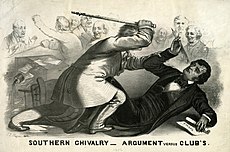
The Caning of Charles Sumner: With tension rising in Kansas, so is it in governement; which greatly debated what to do with the Western territories. Senator Charles Sumner gave a speech accusing pro-slavery senators; naming Andrew P. Butler or South Carolina. Several days later on May 22, Butler's cousin; Preston Brooks, approached Sumner and criticised Sumner's speech. And before Sumner could respond, Brooks pulled out a gold-handed cane and beat him savagely, leaving the senator wounded and bleeding on the floor. The violence over slavery was now in the central government. My Southerners found this action of Brooks to be heroic, but it also showed and strengthened Northern determination to end this slavery.
Monday, December 12, 2011
Kansas-Nebraska Act

Passed in May 1854 by Congress, the two new territories of Nebraska and Kansas were decides on the slavery issue. There was a hug debate over the whole thing, because Congress needed an equal balance, but Northerners were were outraged with the bill, saying that the bill broke the promise to limit slavery. But in order to keep some of the peace between the two, Stephen Douglas came up with the idea of the Kansas-Nebraska Act. This Act made it so that Nebraska belonged to the North, right next to the free state of Iowa. And Kansas would belong to the South, right next to the slave state of Missouri. This kept the representation in Congress equal.
Friday, December 9, 2011
Fugitive Slave Act/Civil Disobedience

In New York, a newspaper accounts of a story of an African American; Henry Long was captured in the North. He was waiting tables in New York, when kidnappers seized him. Although Long had been living up North for several months before his escape, he was forced back to the South and into slavery. The New York Independent stated that "almost no colored man is safe in our streets."
The Fugitive Slave Act of 1850, states that an African American who had escaped from slavery could only be pointed as a runaway to take him or her into custody. They were then sent to court, and would have a testimony by white witnesses and then that slave would be sent south again. But the African Americans were not allowed to testify in court. The federal commissioner in charge of deciding the fate for the African American would be paid $10 for sending a slave back south, and $5 for the decision to send them back north. And any northerner who didn't help capture a slave could be jailed. This could be thought of as civil disobedience becuase as a community and one nation the two societies would not do things that the other side requested, which led to tension among America.
Thursday, December 8, 2011
Wilmont Proviso/Popular Sovereignty
David Wilmont, was a democrat from Pennsylvania. He purposed that any territory the United States got from Mexico would have no slavery, and no involuntary servitude; this became known as the Wilmont Proviso. Wilmont along with other Northerners thought that President Polk was "pro-Southern" because of his support for a new tariff in the South. This mad Southerners mad though, they believed any antislavery decisions would end up effecting all slavery issues everywhere. The Wilmont Proviso was passed by the House of Representatives, but not by the Senate. Senator John C. Calhoun tried to come up with a solution but people in the Senate didn't want any part of it. Which angered Southerners even more. With tensions rising between Congress, Senator Lewis Cass purposed a solution. He suggested the idea that each citizen in the new territory should be allowed to decide if slavery was allowed or not. This became known as popular sovereignty. Congress liked this idea, because it took slavery issues out of the national government. Abolitionists argued though that is denied African American rights. But many northerners, especially in the Midwest supported the idea because most of the citizens would be Northern, therefore banning slavery. This would later lead to other issues in the government. But at the time it settled some of the tension. 
Subscribe to:
Comments (Atom)